Categories
- Church & Parish Records-> (723)
- Diocesan & Ecclesiastical-> (17)
- Electoral Registers & Poll Books-> (4)
- Heraldry-> (2)
- |_ Coats of Arms & Crests (0)
- |_ College of Arms Records (0)
- |_ Heraldic Visitations (0)
- |_ Landed Gentry (1)
- |_ Peerage & Baronetage (1)
- Historical Directories-> (1366)
- Land & Property Records-> (0)
- Medieval Records-> (11)
- Military Records-> (3)
- Professional & Trade Records-> (24)
- School Registers & Yearbooks (0)
- Telephone Books (2)
- Travel Topography Local History (18)
- Specials ...
- New Products ...
- Featured Categories...
- All Products ...

Manufacturers
Reviews [more]
Sponsors

Heraldry
The Visual Language of Lineage: Heraldry and the Great Aristocratic Directories
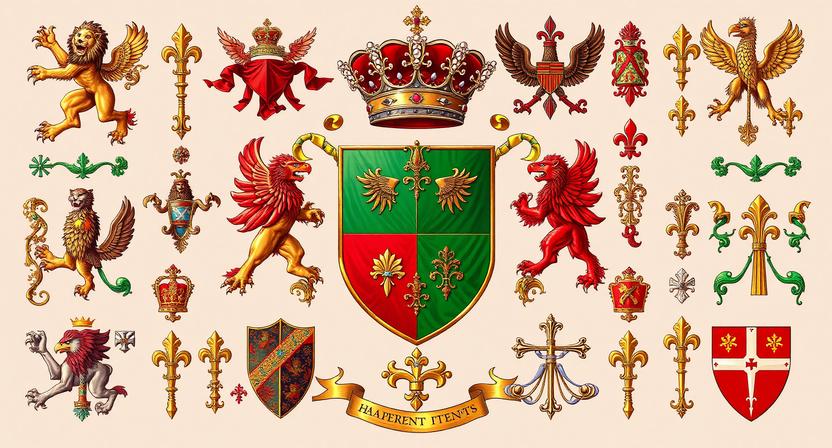
Heraldry is far more than the colorful shields and medieval pageantry often seen in movies; it is the world’s oldest form of graphical identification and data storage. Developed in the Middle Ages when armor made faces unrecognizable, heraldry provided a highly codified, instantly recognizable visual "logo" for knights and noble families.
At its core, heraldry is a strict system of rules. It dictates how colors (tinctures), metals, furs, and symbols (charges) can be arranged on a shield so that no two families look alike. Because coats of arms were inherited through the male line—subject to complex rules of "cadency" that added marks to a son’s shield to show he was not the firstborn—a family’s armorial bearings became a visual family tree.
To keep track of who had the right to bear which arms, and who inherited which titles, massive reference directories were created. These books are the encyclopedias of the aristocratic world. If you open the pages of Kelly's Handbook, Debrett's, or the Almanach de Gotha, you are looking at the mechanical gears of high society and royal succession. Here is exactly what kind of things you will find inside them:
Debrett’s Peerage & Baronetage
Often referred to as the "blue book" of the British establishment, Debrett’s is the authoritative record of the UK’s titled classes. Inside, you will find exhaustive, multi-generational family trees. The entries focus intensely on precision of inheritance. You will see the exact date a title was created by a monarch, the precise legal wording of who can inherit it (the "remainder"), and a chronological list of every person who has held that title. Naturally, each entry is headed by the family’s coat of arms, beautifully described in heraldic "blazon."
Kelly's Handbook to the Titled, Landed, and Official Classes
If Debrett’s is strictly for the highest nobility, Kelly's is the broader social directory of the British elite. First published in the late 19th century, it bridges the gap between the aristocracy and the upper-middle classes. Inside Kelly's, you won't just find Dukes; you will find Knights, Baronets, military generals, high-ranking civil servants, and the "landed gentry" (wealthy landowners who didn't hold peerages). The entries are highly practical for social networking: they list a person’s country estate (e.g., "Seat: Balmoral Castle"), their London townhouse address, their private gentlemen's clubs (like White's or Brooks), who they married, and who their heir is.
The Almanach de Gotha
The Gotha is the undisputed heavyweight champion of royal genealogy. Published in Germany from 1763 until World War II, it mapped out the incredibly tangled family trees of Continental Europe. The book was famous for its strict, snobbish hierarchy, divided into two parts. Part I listed the "Reigning and Sovereign Houses" (the acting kings, queens, and princes of Europe). Part II listed the "Mediatized" houses—ancient royal families who lost their thrones to Napoleon but were legally recognized by the European powers as still being "royal." Inside the Gotha, you will find dense, mind-bending dynastic charts showing how the royal families of Britain, Germany, Russia, Spain, and France were all intermarried. It also details the highly elaborate heraldic "achievements" of these families, complete with crowned helmets, royal mantles, and jeweled collars of chivalric orders.
Ultimately, these directories are the physical marriage of heraldry and genealogy. They do not just record history; they dictate social rank, proving who has the right to stand in the presence of a monarch, and who has the right to bear a specific ancient shield.

New Products For June - Heraldry
Sponsors

Information
Have you seen ...
Who's Online